

From Nanoparticle Musings to Le Creuset Casserole Bargains

Andrew Bluett-Duncan
Director

We’ve reached that familiar point in the year, post-Christmas, when, as a company, we look back at what went right, what went wrong, and how on earth we’ve ended up with 100 Le Creuset round casseroles (or an excess of Le Creuset's U mugs) in Shell Pink, which, this time last year, were flying out of the door. Where did we go wrong?
So, this week I have a number of overstock offers that I hope you’ll find enticing.
A meander
But before I get to those, and entirely apropos of nothing, other than the fact I’m sitting here staring at a computer screen, I do find myself occasionally worrying about what the internet is doing to our society. That said, it undeniably has its upsides, particularly when it comes to communication. This email is one example (you may view it otherwise?). Another, for me, has been YouTube as a disseminator of information.
But before I get to those, and entirely apropos of nothing, other than the fact I’m sitting here staring at a computer screen, I do find myself occasionally worrying about what the internet is doing to our society. That said, it undeniably has its upsides, particularly when it comes to communication. This email is one example (you may view it otherwise?). Another, for me, has been YouTube as a disseminator of information.
Because of its ease of access, I’ve come across a number of people who, over time, have earned my respect. From them I’ve learnt more about the importance of food ( I am what I eat) and about the alarming rise of ultra-highly processed foods, which are quietly doing us no favours. Diabetes and widespread weight issues being just two obvious consequences.
A year or two ago, a friend told me about Yuka, a phone app that scans barcodes on food and scores products out of 100 for nutritional quality and safety. I downloaded it, and it’s been in regular use ever since. The other day we bought a Chicken Seasoning mix from Sainsbury’s and, out of curiosity, I scanned it, fully expecting a high score. In fact, it was rated poorly. Yuka explains its reasoning, and in this case the culprit was silicon dioxide, a commonly used anti-caking agent added to powdered foods to prevent clumping in damp conditions. |  |
Nanoparticles: the potential health risk you may be consuming
Yuka’s concern with silicon dioxide isn’t alarmist. It is though, questioning the motives for its use by the food industry and highlighting the lack of conclusive proof at this time as to whether silicon dioxide is completely safe.
Yuka’s concern with silicon dioxide isn’t alarmist. It is though, questioning the motives for its use by the food industry and highlighting the lack of conclusive proof at this time as to whether silicon dioxide is completely safe.
This additive can contain nanoparticles, and a growing body of research suggests these may persist in the gut, may disrupt the microbiome, and so interfere with immune balance, with possible links to inflammatory bowel disease and coeliac disease in susceptible individuals.
Regulators currently maintain that it is safe at permitted levels, while also conceding that long-term human data on nanoparticles is incomplete, and that no clear daily intake level can yet be set. Which leads me to a possibly uncomfortable question. When the science is still unclear and early research has raised question marks, I wonder whether the food industry should avoid (or be regulated to avoid) their use until such time as independent research has been allowed to draw longer term conclusions?
It seems that both government and food companies lack the resolve to face these important issues.
In that light, I also wonder whether a little healthy scepticism in choosing what we buy (and using apps like Yuka) might well be a sensible.

To product & overstock offers
As I mentioned earlier, we do have an overstock of Le Creuset's round casseroles and to set the scene, below is a taster of what our website has to say about cooking with Enamelled Cast Iron.
As I mentioned earlier, we do have an overstock of Le Creuset's round casseroles and to set the scene, below is a taster of what our website has to say about cooking with Enamelled Cast Iron.
At home we, with some regularity, create a very tasty coq-au-vin, first sealing the chicken pieces in the casserole on the hob, finishing with me in tears as I watch Jeanne pour in a bottle of my best St. Emilion before I taste the final result and forgive her, her extravagance.
Understanding Enamelled Cast Iron
Enamelled cast iron is a marvel of culinary engineering, combining the robust heat retention of traditional cast iron with the convenience of a non-reactive cooking surface.
Enamelled cast iron is a marvel of culinary engineering, combining the robust heat retention of traditional cast iron with the convenience of a non-reactive cooking surface.
At its core, it's regular cast iron that has been coated with a layer of enamel - a type of glass that's fused to the iron through a high-temperature firing process.
Key Benefits
Non-Reactive Surface
The enamel coating creates a barrier between your food and the iron beneath
The enamel coating creates a barrier between your food and the iron beneath
Brilliant for cooking acidic foods like tomatoes, wine-based sauces, and citrus without any metallic taste or reaction
Unlike bare cast iron, you can safely marinate foods directly in your enamelled cookware, without it leaching into your pan
Easy to Clean
The smooth, non-porous enamel surface prevents food from sticking and makes cleaning a breeze
The smooth, non-porous enamel surface prevents food from sticking and makes cleaning a breeze
Most often, a simple soak in warm, soapy water is all that's needed to remove any residue
Unlike traditional cast iron, you can use mild soap without fear of damaging the cooking surface
No Seasoning Required
Traditional cast iron needs regular seasoning to maintain its non-stick properties and prevent rusting
Enamelled cast iron comes pre-seasoned from the factory - the enamel coating acts as a permanent seasoning
This saves time and effort in maintenance, making it more user-friendly for busy cooks
Available in Lots of Colours
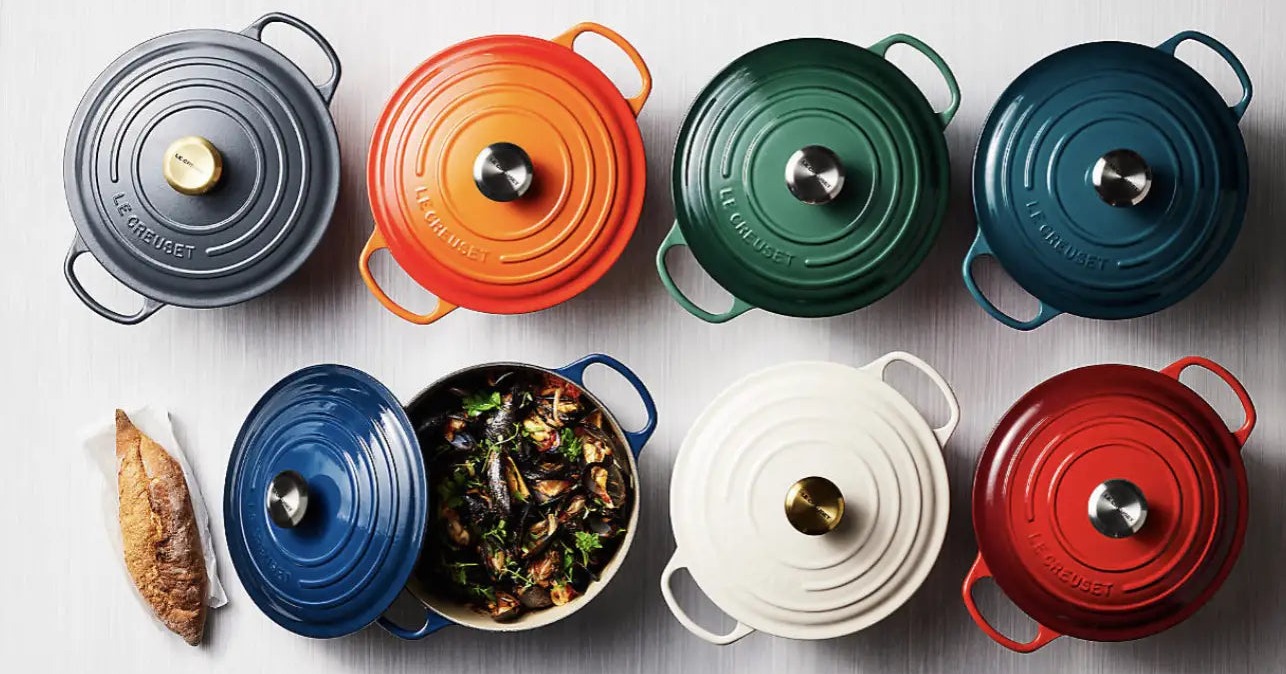
Enamelled cast iron cookware comes in a wide range of vibrant colours
Enamelled cast iron cookware comes in a wide range of vibrant colours
This allows for a seamless transition from cooktop to table, adding a touch of style to your dining presentation
The ability to match your cookware to your kitchen decor is an added aesthetic bonus
Excellent Heat Retention and Distribution
Like traditional cast iron, enamelled versions excel at retaining heat
Once hot, they maintain a steady temperature, perfect for long, slow cooking methods
The cast iron core ensures even heat distribution, eliminating hot spots that can lead to burnt food
Versatility
Enamelled cast iron is safe for use on all cooking surfaces, including induction hobs
It can go directly from hob to oven, making it ideal for recipes that require both stovetop and oven cooking
Many pieces are attractive enough to double as serving dishes, reducing the number of pots and dishes you need to use and clean
Enamelled cast iron is safe for use on all cooking surfaces, including induction hobs
It can go directly from hob to oven, making it ideal for recipes that require both stovetop and oven cooking
Many pieces are attractive enough to double as serving dishes, reducing the number of pots and dishes you need to use and clean
Recipe Idea: Classic Beef Bourguignon
This classic French dish showcases the benefits of low and slow cooking in enamelled cast iron, resulting in tender meat and a rich, flavourful sauce.
This classic French dish showcases the benefits of low and slow cooking in enamelled cast iron, resulting in tender meat and a rich, flavourful sauce.
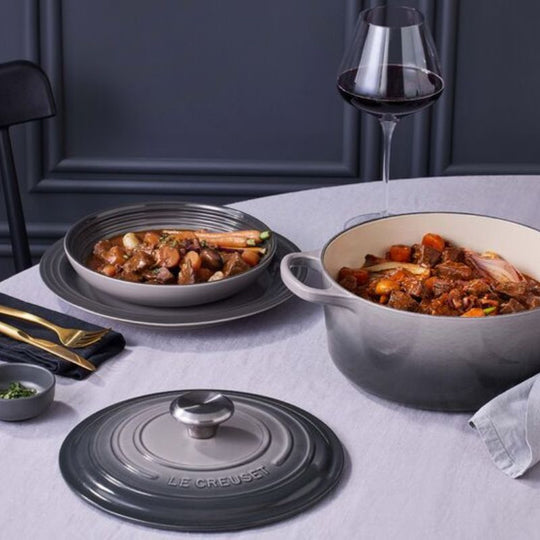 | Preheat your enamelled cast iron casserole over medium-low heat Brown 1kg of cubed beef in batches, then set aside In the same pot, sauté 200g lardons, 1 sliced onion, and 2 sliced carrots Add 2 cloves of minced garlic and 1 tbsp tomato paste, cook for 1 minute Return the beef to the pot, add 750ml red wine, 250ml beef stock, and a bouquet garni Bring to a simmer, cover, and transfer to a 150°C oven for 3 hours After 3 hours, add 200g pearl onions and 200g mushrooms and return to the oven for another hour. Easy as that! |


Enamelled cast iron cookware offers the best of both worlds: the heat retention of cast iron with the ease of use of non-stick pans. By following a few simple guidelines, you'll be able to create delicious meals whilst maintaining your cookware for years to come.
Whether you're simmering a hearty stew, baking artisanal bread, or searing a perfect steak, your enamelled cast iron will be your reliable kitchen companion.
Remember, the key to success with enamelled cast iron is patience.
Take the time to preheat properly, avoid extreme temperature changes, and care for your cookware gently. With these practices, your enamelled cast iron will serve you well for generations, becoming a treasured part of your culinary journey.
From one-pot wonders to gourmet creations, enamelled cast iron opens up a world of cooking possibilities.
So go ahead, experiment with new recipes, and enjoy the wonderful meals you'll create with your enamelled cast iron cookware.
OK that’s it for this week.
I hope you have a pleasant and peaceful weekend.
I hope you have a pleasant and peaceful weekend.
Warm regards,
Andrew
Leave a comment