


Kitchen Knife Buying Guide
Kitchen knives are the single most important tool in any cook's kitchen, yet most people struggle with dull, ill-fitting blades for years before making a considered choice. This guide covers which knives you actually need and which are optional extras, how steel and construction affect performance, which brands we stock and why, and how to care for your knives properly so they last for decades.
Overview
- A 20cm chef's knife handles approximately 90% of kitchen tasks and is the only essential purchase to start with.
- Quality knives last decades, take finer edges, and are genuinely safer than cheap ones because sharp blades require less pressure to control.
- German knives (Wüsthof, Zwilling) are heavier and more forgiving. Japanese knives (Global) are lighter and hold a finer edge longer.
- Forged knives outperform stamped ones for daily use. Full tang construction is essential for any knife you intend to use seriously.
- Never put kitchen knives in the dishwasher under any circumstances.
Where to start
- Buying your first knife? A 20cm chef's knife handles everything
- Prefer precision vegetable work? Consider a Japanese santoku instead of a chef's knife
- Building a core set? Chef's knife, paring knife, and bread knife covers 95% of tasks
- Buying as a gift? A single exceptional chef's knife outperforms a cheap block set every time
- Struggling with dull knives? Learn honing first, it extends time between sharpenings dramatically
| Knife | Best For | Typical Size | Priority |
|---|---|---|---|
| Chef's / Cook's Knife | 90% of kitchen tasks | 20cm (8") | Essential |
| Paring Knife | Detailed work, peeling | 8-10cm (3-4") | Essential |
| Bread Knife | Bread, tomatoes, cakes | 20-23cm (8-9") | Very useful |
| Santoku Knife | Alternative to chef's knife | 17-18cm (7") | Optional alternative |
| Utility Knife | Medium-sized tasks | 12-15cm (5-6") | Nice to have |
| Carving Knife | Roasts, large joints | 20-25cm (8-10") | Occasional use |
Why Quality Matters
The economics of buying wellQuality kitchen knives cost more upfront, but the maths works in their favour over time. A £15 supermarket knife that needs replacing every two years costs £150 over two decades. A £120 Wüsthof or Global knife that lasts 30 years costs around £4 per year, with superior performance every single time you use it.
- Longer functional life: Decades, not years, with proper care
- Superior edge retention: Stays sharp longer between sharpenings
- Takes a finer edge: Achieves and maintains true razor sharpness
- Better balance and ergonomics: Reduces hand fatigue during extended prep
This seems counterintuitive to beginners, but it is absolutely true. The majority of knife accidents happen with dull blades, because you apply more pressure to compensate for the dullness, which increases the chance of slipping. A freshly sharpened knife slices through food smoothly with minimal pressure, giving you far more control.
Good to know: High-quality knives show obvious performance differences between sharp and dull, making maintenance easy to judge. Budget knives feel roughly the same whether sharp or dull, so you never know when to sharpen them.
Essential Knife Types
Chef's Knife / Cook's KnifeIf you only buy one knife, make it this one. A proper chef's knife handles approximately 90% of kitchen tasks. The curved blade creates a rocking motion when chopping. The deep heel keeps knuckles safely above the cutting board. The broad blade doubles as a tool for transferring chopped ingredients.
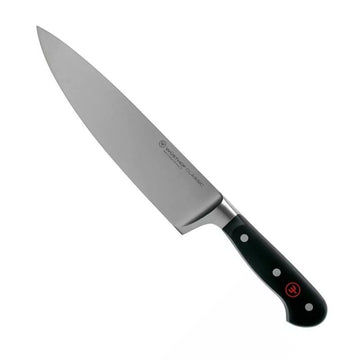
- 15cm (6"): For smaller hands or those wanting maximum control
- 20cm (8"): The sweet spot for most home cooks, versatile and manageable
- 23-25cm (9-10"): For larger hands or professional-style prep work
It excels at chopping vegetables, slicing meat, mincing garlic and herbs, and breaking down a chicken. Do not use it for prying, twisting, or cutting through bones.
Paring KnifeSmall, nimble, and essential for detailed work. The short blade (8-10cm) gives you control for tasks the chef's knife cannot manage cleanly. Some cooks prefer working with a paring knife in hand rather than on a board, which is perfectly safe with proper technique.
Best for: peeling apples and potatoes, deveining prawns, hulling strawberries, removing seeds, segmenting citrus, trimming mushrooms, any task requiring precision.
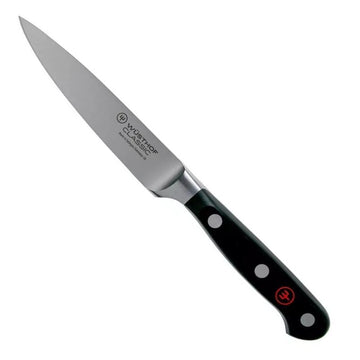
Expert tip: A sharp paring knife often works better than a peeler for irregular vegetables. You have more control and can follow the contours more naturally.
The serrated blade applies cutting pressure from multiple angles, slicing through soft foods without crushing them. Each tooth saws through a tough crust while treating the soft interior gently. A straight-edged knife would compress and tear. Beyond bread, it handles ripe tomatoes, cakes, pastries, and anything with a tough skin and soft interior.

Sharpening note: Serrated knives rarely need sharpening, quality ones last decades. When they do eventually dull, they require specialist sharpening. Buy quality once.
The word loosely translates as "three virtues", slicing, dicing, and mincing. It has become a popular alternative to the Western chef's knife, particularly among cooks who prefer a lighter blade.
Choose based on which feels better in your hand and matches your natural cutting style. You do not need both unless you are a serious knife enthusiast.

| Feature | Chef's Knife | Santoku |
|---|---|---|
| Blade shape | Curved, pointed tip | Straighter edge, squared-off tip |
| Cutting motion | Rocking | Decisive downward cuts |
| Blade thickness | Standard | Typically thinner, less drag |
| Typical length | 20-25cm | 17-18cm |
Sits between a chef's knife and a paring knife in size. Useful for tasks where the chef's knife feels too large and the paring knife too small: slicing smaller fruits, trimming meat, preparing sandwiches, cutting cheese. Many cooks never buy one, happily using just their chef's and paring knives. Genuinely optional.

- Length: Should exceed the length of your largest roast for smooth single-stroke cuts
- Thin blade: Reduces tearing and maintains slice presentation
- Some flexibility: Helps follow bone contours cleanly

Long, thin, and designed for one purpose: cutting neat, uniform slices from large roasts. If you regularly cook Sunday roasts or holiday joints, this knife transforms the carving experience. For occasional carving, a chef's knife handles the job adequately. The carving knife is a considered addition, not an essential.
Knife Anatomy Explained
Understanding knife anatomy helps you make informed purchasing decisions and explains why certain knives perform better than others.
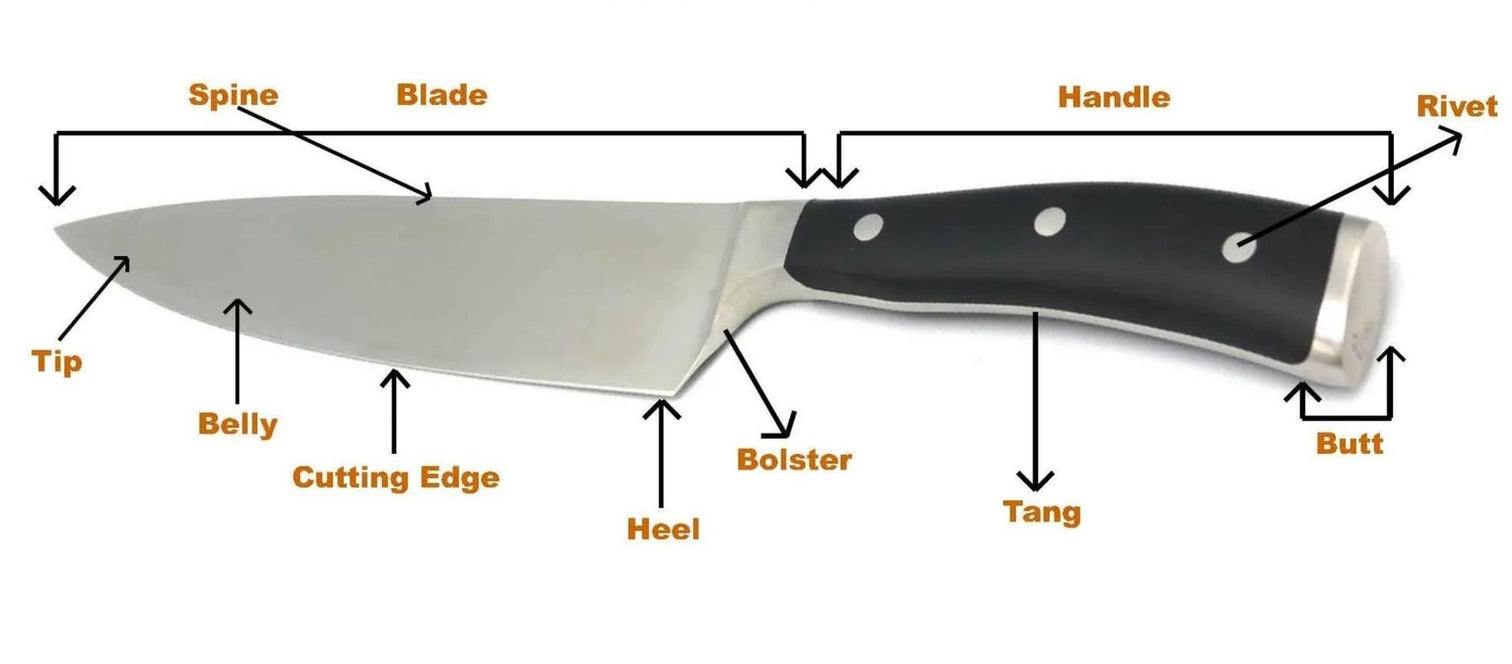
| Part | What it does |
|---|---|
| Tip | Where spine and edge meet. Used for piercing, scoring, and anchoring the rocking motion on a chef's knife. |
| Belly | The curved section after the tip. A pronounced belly suits rocking; a flatter belly suits push-cutting (santoku style). |
| Edge | The sharp cutting surface. Can be smooth or serrated. Steel quality determines how well it holds an edge. |
| Spine | The thick, dull top of the blade. Provides weight and rigidity. A thick spine indicates a sturdy knife. |
| Bolster | The thick junction where blade meets handle. Found on forged knives only. Adds balance and finger protection. |
| Heel | The rear blade section near the handle. Where maximum force is applied for tough cutting tasks. |
| Tang | Critical. The metal extension running into the handle. Full tang (runs the full length) is far stronger than partial tang. Always choose full tang for serious knives. |
| Handle | Wood, plastic, or metal. Must feel comfortable and be balanced against blade weight. Personal preference plays a large role here. |
| Rivets | Metal pins fastening handle to tang. Three rivets is standard on quality knives. Check they sit flush, protruding rivets irritate your hand. |
Steel & Construction
Forged vs StampedThese terms describe how a knife was made. It is one of the most significant quality indicators.
Forged knives
Steel heated to extreme temperatures, then hammered or pressed into shape. Creates denser, stronger steel with better balance.
- Superior balance and weight distribution
- Denser steel, more durable
- Full tang construction standard
- Bolster adds finger protection
- Better edge retention
Best for: any knife you use daily.
Stamped knives
Cut from flat steel sheet like a cookie cutter, then sharpened and finished. Less labour-intensive to produce.
- Lower cost, more accessible
- Lighter weight
- Easier to sharpen (no bolster)
- Less durable overall
- Poorer balance
- Dulls faster than forged
Acceptable for: occasional-use knives.
The steel determines how your knife performs, how long it stays sharp, and how much maintenance it needs.
| Steel | Used by | Hardness | Characteristics |
|---|---|---|---|
| German stainless (X50CrMoV15) | Wüsthof, Zwilling | 56-58 HRC | Excellent corrosion resistance, easier to sharpen, requires more frequent maintenance. Forgiving and versatile. |
| Japanese stainless (VG-10, AUS-10) | Global, Shun | 59-61 HRC | Superior edge retention, achieves finer edges, slightly more brittle, needs more careful handling. Less maintenance frequency. |
| Carbon steel | Traditional French/Japanese makers | 62+ HRC | Finest possible edge, easiest to sharpen to razor sharpness. Develops patina. Requires immediate drying to prevent rust, not stainless. |
The Rockwell Scale (HRC): Measures steel hardness. Harder is not automatically better, it is a trade-off between edge retention and ease of sharpening. Harder steels hold an edge longer but are more brittle and harder to sharpen when they do eventually dull.
German (Wüsthof, Zwilling)
- Heavier blades for momentum cutting
- Curved edge for rocking motion
- Full bolster for finger protection
- Softer steel, easier maintenance
- Sharpened to 20° angle
- Emphasis on durability and forgiveness
Japanese (Global, Shun)
- Lighter blades for precision control
- Straighter edge for push-cutting
- No bolster, blade extends to handle
- Harder steel, superior edge retention
- Sharpened to 15° angle
- Emphasis on sharpness and precision
Neither is better. German knives are more forgiving and versatile; Japanese knives offer unmatched precision. Choose based on your cooking style and willingness to maintain the blade carefully.
How Our Brands Compare
After over five decades in business, we stock only brands that have consistently delivered quality and backed their products. Here is how they differ and which buyer each one suits.
| Brand | Strengths & Characteristics | When a Buyer Might Choose It |
|---|---|---|
| Global | Japanese design with hollow, weighted handles for perfect balance. Seamless construction for maximum hygiene. Razor-sharp VG-10 steel, hardened to 56-58 HRC. | Cooks who prioritise precision and lightness, or who prefer Japanese cutting technique. Also popular with those wanting a clean, modern aesthetic. |
| Wüsthof | German forging since 1814. Made in Solingen, the "City of Blades." X50CrMoV15 steel, full bolster, exceptional balance. Seven generations of family ownership. | Cooks wanting reliable, durable, all-purpose knives with a traditional feel. The go-to recommendation for most home cooks. |
| Zwilling J.A. Henckels | Solingen heritage since 1731. Master bladesmiths train for 8 years before crafting each knife. Exceptional balance and Solingen-quality steel. | Those who want near-professional performance and appreciate the heritage of one of the world's oldest knife makers. |
| Robert Welch | British design excellence. Signature range offers beautiful aesthetics alongside practical function at an accessible price point. | Design-conscious cooks who want knives that look as good as they perform, and prefer British craftsmanship. |
| Taylor's Eye Witness | Sheffield heritage since 1838. Honest, dependable British craftsmanship. Excellent entry-level options without compromising on quality. | Budget-conscious buyers wanting real quality from a genuine British heritage brand, not a cheap import. |
| Sabatier | Classic French knife-making tradition with an iconic blade profile that has stood the test of time. A professional kitchen staple for generations. | Cooks who prefer traditional French technique or want a classic profile that generations of chefs have trusted. |
Wüsthof has been a family company since 1814, manufacturing exclusively in Solingen, Germany. In medieval times, the swordsmiths of Solingen designed the town's coat of arms, a testament to a blade-making heritage that remains intact seven generations later.
Zwilling J.A. Henckels has been crafting cutlery in Solingen since 1731, nearly 300 years of blade-making expertise. Their master bladesmiths train for 8 years before earning the right to produce your knife. That apprenticeship system, unchanged for centuries, ensures traditional skills pass from generation to generation.
Sets vs Individual Knives
Why individual knives are usually the better choiceKnife block sets look impressive and seem like good value. After over five decades selling cookware, we have observed that most cooks regularly use only 2-3 knives from an 8-12 piece set. Building your own collection piece by piece ensures you invest only in knives you will actually use.
The typical block set breakdown
- Chef's knife: You'll use this constantly
- Paring knife: You'll use this regularly
- Bread knife: You'll use this if you buy bread
- Utility knife: You might use this occasionally
- Carving knife: Once or twice a year perhaps
- Steak knives: Only if you regularly eat steak at home
- Additional knives: Unlikely to be touched
A typical 10-piece set at £300-£500 means paying for knives you will not use. That same £300 spent on three exceptional knives you use daily is almost always the better investment.
- You are furnishing a kitchen from scratch and genuinely need everything
- You use all the included knife types regularly
- The set offers genuine savings over individual pieces at equivalent quality
- You want matching aesthetics throughout your collection
- It is a wedding gift and the couple has requested it
Quality knives make exceptional gifts for cooks at any level. Here is how to choose well:
| Recipient | Best Approach | Budget Guide |
|---|---|---|
| Wedding gift | Wüsthof or Zwilling block set, or a single chef's knife if they are building gradually. Check the registry first. | £200-£400 |
| Experienced home cook upgrading | A single exceptional knife in a style they do not already own: a 20cm Global chef's knife, a Japanese santoku, or a quality bread knife. | £80-£150 |
| Professional chef | Professionals have strong preferences, a gift voucher is often the safest option. Otherwise, premium sharpening equipment or a specialist knife. | £50-£200 |
| Keen amateur | Upgrade their most-used knife to a premium version, or a quality magnetic knife rack if they are short on counter space. | £60-£120 |
Cultural note: In some cultures, giving knives as gifts is considered unlucky. If concerned, include a small coin with the gift. The recipient "pays" it back to you symbolically, making it a purchase rather than a gift and sidestepping the superstition.
What Customers Ask Most
Do I really need expensive kitchen knives, or will budget ones do?
Budget knives will cut food, but the experience and results differ significantly. High-quality knives offer a longer functional life (decades vs years), better edge retention, superior balance with less hand fatigue, and genuinely safer use through sharper edges requiring less pressure. They also show noticeable performance changes when dull, making maintenance easier to judge. Over 20-30 years of use, quality knives prove more economical than repeatedly replacing budget alternatives.
What's the difference between German and Japanese knives?
German knives (Wüsthof, Zwilling) feature heavier blades with curved edges designed for rocking motion, full bolsters for finger protection, and softer steel (56-58 HRC) that is easier to sharpen but needs more frequent attention. Sharpened to 20°. Japanese knives (Global, Shun) use harder steel (59-61 HRC) that holds edges longer, thinner blades for precision, lighter weight, and often no bolster. Sharpened to 15°. German knives excel at heavy-duty tasks and forgiveness; Japanese knives provide superior precision. Choose based on your cutting style.
How often should I sharpen my kitchen knives?
For regular home use, sharpen every 2-3 months. Professional kitchens sharpen weekly due to constant use. Frequency depends on usage intensity, cutting surface hardness, steel quality (harder Japanese steel needs less frequent sharpening), and what you are cutting (bones dull blades rapidly). Use the paper or tomato test to judge, do not sharpen on a fixed schedule regardless of actual performance.
What knife should I buy first if I'm starting from nothing?
A 20cm chef's knife handles approximately 90% of kitchen tasks. Choose from a reputable brand with a handle that feels comfortable and balanced in your hand. Invest £80-£150 for quality that lasts decades. Once comfortable with this, add a paring knife (£30-£50) for detailed work and a bread knife (£40-£80) for serrated tasks. Build based on actual use, not pre-packaged sets.
Can I put my kitchen knives in the dishwasher?
No, never. Despite some manufacturers claiming dishwasher compatibility, dishwashers damage knives through multiple mechanisms: blades bang against other items causing chips, high heat warps wooden handles and degrades plastic, prolonged moisture causes corrosion, and harsh detergents loosen rivets. Hand washing takes 30 seconds, wash in warm water with mild detergent, rinse, dry immediately. This extends knife life from years to decades.
What's the difference between forged and stamped knives?
Forged knives are heated and hammered into shape, creating denser steel with better balance, full tang construction, bolsters for finger protection, and superior durability. They are heavier, more expensive, and perform better for serious cooking. Stamped knives are cut from flat steel sheet, lighter, less expensive, no bolsters, generally less durable. For daily-use knives (chef's, paring), invest in forged. For occasional-use knives, stamped is acceptable.
How do I know when my knife needs sharpening?
Three simple tests: the paper test (fold paper in half, stand upright, slice from top to bottom, a sharp knife cuts cleanly through standing paper); the tomato test (sharp knives penetrate ripe tomato skin under their own weight, dull ones require pressing and tear); the onion test (sharp cuts leave cells intact with less eye-watering, dull ones crush cells releasing more of the irritant). Quality knives show clear performance degradation when dull, unlike cheap knives that feel the same sharp or dull.
What is a full tang and why does it matter?
Full tang means the blade metal extends completely through the handle to the butt end, typically visible along the handle sides with rivets attaching the handle scales. This provides superior balance (weight distributed throughout the full knife), structural strength (prevents handle breaking under stress), and a significantly longer lifespan. Partial tang knives have metal extending only partway, making them prone to breaking at the handle junction when cutting tough materials. Always choose full tang for any serious knife.
Should I buy a knife block set or individual knives?
Individual knives are strongly recommended for most buyers. Most cooks regularly use only 2-3 knives: chef's knife, paring knife, and bread knife. Building your collection piece by piece ensures you invest in knives you actually use rather than filling block slots with unused items. This approach typically costs less overall and gives you better quality in the knives you use daily. Sets often include lower-quality knives to hit a price point.
What's the best steel for kitchen knives?
No single best steel exists, it depends on priorities. German stainless steel (X50CrMoV15) offers excellent corrosion resistance, easier sharpening, and good forgiveness for all-round cooking. Japanese steels (VG-10, AUS-10) provide superior edge retention and finer edges, but require more careful maintenance and are slightly more brittle. Carbon steel holds the finest possible edge but requires immediate drying and is not rust-resistant. For most home cooks, German or Japanese stainless provides the best balance of performance and practicality.
How should I store my kitchen knives safely?
Knife blocks keep knives organised on the worktop with blades safely concealed, they take up counter space and slots need cleaning, but they are reliable and safe. Magnetic wall racks save counter space, accommodate any knife size, and make access easy, they require wall mounting and keep blades exposed, so they should be positioned well away from children. Drawer inserts or individual sheaths protect blades without taking up counter space. Never store knives loose in a drawer, blade contact with other utensils dulls edges rapidly and creates a safety hazard.
What's the difference between honing and sharpening?
Honing realigns the blade edge without removing metal, using a honing steel. Do this before each use or at minimum weekly. It takes seconds and is routine maintenance. Sharpening removes metal to create a new edge, using sharpening stones, an electric sharpener, or a professional service. Do this every 2-3 months for home use, it requires proper technique and cannot be done daily without wearing away the blade. Regular honing extends time between sharpenings significantly. Think of honing as daily toothbrushing, sharpening as the periodic professional clean.
Why do my knives dull so quickly?
Several common causes: cutting on glass, marble, or ceramic surfaces dulls edges immediately; dishwasher use damages blades through contact and harsh detergents; storing knives loose in drawers where blades contact other utensils; improper technique such as pushing sideways or twisting; steel quality that simply will not hold an edge; insufficient honing between sharpenings; and cutting through bones or frozen food. Address these and quality knives will stay sharp for months between proper sharpenings.
Care, Sharpening & Maintenance
Stay away from the dishwasher! Never put kitchen knives in the dishwasher, even those marketed as "dishwasher safe." Blades bang against other items and chip. High heat warps wooden handles and degrades plastic. Prolonged moisture causes pitting and rust even on stainless steel. Harsh detergents loosen rivets over time. Hand washing takes 30 seconds and extends knife life by decades.
- Clean immediately after use, acidic foods (tomatoes, citrus) damage steel if left sitting
- Wash with warm water and mild washing-up liquid, hold by the handle, wipe from spine to edge, never along the edge
- Rinse thoroughly, soap residue affects flavour and degrades handles over time
- Dry immediately and completely, use a clean towel, including handle crevices. Even stainless steel can spot with prolonged moisture
Never put knives loose in a drawer where blades contact other utensils. This dulls edges rapidly and creates a safety hazard.
Knife blocks
- Keeps knives organised and accessible on the worktop
- Protects blade edges
- Blades safely concealed
- Takes up counter space
- Slots can harbour bacteria if not cleaned regularly
Magnetic wall racks
- Saves counter space, wall or cabinet mounted
- Easy to clean, no slots
- Accommodates any knife size
- Quick access while cooking
- Requires wall mounting
- Blades exposed, keep away from children
Most people confuse these, but they serve completely different purposes. Both are essential.
| Honing | Sharpening | |
|---|---|---|
| What it does | Realigns the blade edge without removing metal | Removes metal to create a new edge |
| How often | Before each use, or at minimum weekly | Every 2-3 months for home use |
| Tool | Honing steel (the rod in most knife sets) | Sharpening stone, pull-through, or professional service |
| Time | Seconds | Several minutes, or drop off with us |
| Analogy | Daily toothbrushing | Periodic dental cleaning |
How to test sharpness
- Paper test: Fold paper in half, stand it upright, slice from top to bottom. A sharp knife cuts cleanly through standing paper. Struggling or tearing means it needs sharpening.
- Tomato test: A sharp knife penetrates ripe tomato skin immediately under its own weight. Pressing down or tearing means time to sharpen.
- Onion test: Sharp knives make clean cuts with cells intact (less eye-watering). Dull knives crush cells, releasing more of the tear-inducing compounds.
- Pull-through sharpeners: Easy to use, adequate results. Risk removing too much metal if used incorrectly or too frequently.
- Electric sharpeners: Quick and consistent, but expensive and can be aggressive on blades.
- Whetstones: Complete control and the best results, but steep learning curve and time-consuming.
- Guided systems: Combine stone quality with angle guides, a good middle ground.
Global knives work particularly well with their Minosharp water wheel sharpeners. Ceramic wheels guide the blade at the correct angle automatically, preventing the amateur mistakes that ruin expensive knives.
Most beginners grip the handle only, with the index finger extended along the spine for "control." This actually reduces control and tires your hand quickly.
The professional grip: pinch the blade between thumb and forefinger, just in front of the bolster. Curl the remaining three fingers around the handle. This gives superior control, better balance, and significantly less hand fatigue during extended prep.
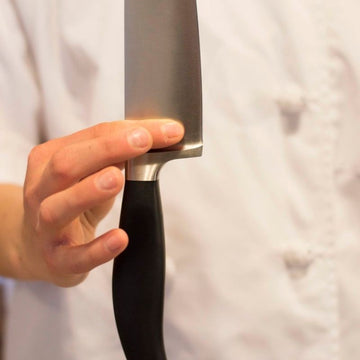
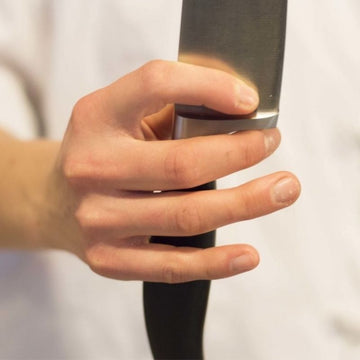
The fundamental rule: your board must be softer than your knife. This allows the blade to bite slightly into the surface rather than impacting something harder that chips or dulls the edge.
| Material | Effect on Knife | Notes |
|---|---|---|
| Glass | Destroys edges immediately | Never use for cutting |
| Marble / Granite | Same as glass | Worktop surface only |
| Ceramic | Too hard | Can chip both blade and board |
| Hardwood (maple, walnut, beech) | Gentle on edges | Naturally antibacterial, self-healing. Needs occasional oiling. Not dishwasher safe. |
| Bamboo | Good | Slightly harder than softwood but still knife-friendly. Sustainable. |
| Plastic / synthetic | Good | Dishwasher safe. Use different colours for different food groups to prevent cross-contamination. |
| Rubber / silicone | Exceptionally gentle | Non-slip, dishwasher safe. Commercial kitchen standard. |
Founded in Reigate in 1972, we've spent over five decades helping customers select quality cookware. We've been twice nominated for the Excellence in Housewares award for customer care, and we stock brands we genuinely believe in, chosen because they perform, not because of margins.
- No-quibble returns, even used items
- Half-price accidental damage replacement for two years
- Price match guarantee
Frequently Asked Questions
What if I've used it and don't like it?
Return it anyway...
How long does delivery take?
Standard delivery...