


How to Ruin a Perfectly Good Knife (and How Not To)

Andrew Bluett-Duncan
Director
Preamble
I was down in the shop the other day making myself a coffee when I was accosted, in the nicest possible way, by Nick, a customer of some considerable standing, who asked me if I’d do a piece on knives.
Therefore, this week, encouraged also by a new range from Robert Welch, I’m doing just that. So, Nick, thank you for prompting me to do so. This one’s for you and you {{ first_name|default:'Art of Living Subscriber' }} maybe, if you’re interested?
I’ll admit right at the start that I’m probably not the ideal person to be writing about knives, because, in the normal run of things, I use only two in the kitchen. A small parer and a Robert Welch 15cm cook’s knife, unless I’m tackling a cabbage or a loaf of bread, in which case a 20cm cook’s knife and a serrated bread knife are the order of the day.
However, you’ve got either me or nothing, and I must have picked something up along the way, as we have been flogging knives since 1972. Back then we only had Lion Sabatier, imported by Elizabeth David, chiefly because there was very little else being brought into the country in those dark days.
Before I go back to this rather fascinating subject, I felt I had to pass this onto you, which I trust won't spoil your Saturday morning.
I read about a rather disturbing report the other day about our 'healthy life expectancy'*, which I'll be returning to in the coming weeks. It says that over the last ten years our expectation of living in good health, has dropped by over two years. Although I was aware the assumption of every generation being healthier than the last was no longer true, I still found this a rather shocking and rapid decline.
*Healthy life expectancy is how many years, on average, a person can expect to live in good health, before illness or disability sets in.
Clearly this is a complex problem with a variety of causes and influencing factors with food, toxins, sleep and stress being some broad examples. I've been reading a little on this recently, but I'd be delighted to read some of your views too, before sharing what I found. Email me (andrew@artoflivingcookshop.co.uk) or post a comment on the online version of this newsletter.
To Product
Returning to my main subject, I've divided my thoughts on all things Knife related into the following sections:
• Sharpening
• Chopping Boards
• Cleaning
• Knife Storage
• Buy good quality
Sharpening
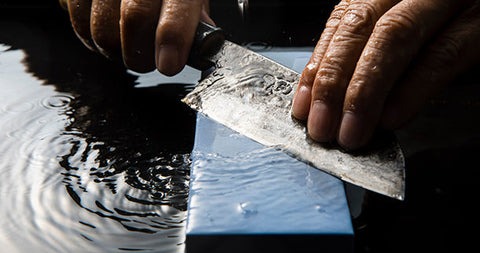
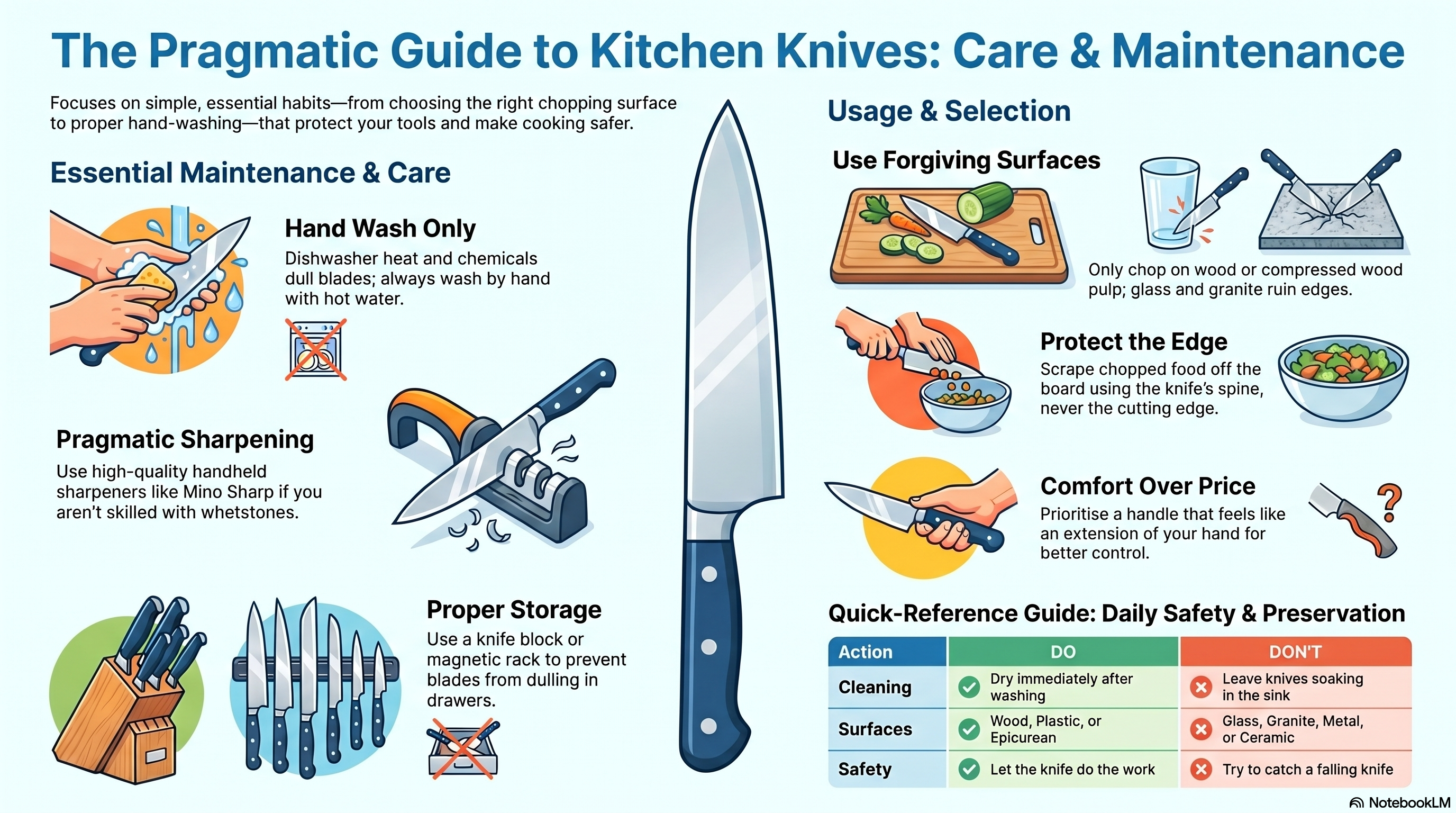
If you love using a whetstone, there is no better way to keep your knives in fine fettle. If you are naturally talented, self-disciplined, particular and, able to hold the blade at a perfectly consistent angle of either 15 or 22.5 degrees (knife dependent), then don’t hesitate to get the stone out when required.
If, however, you are like most of us and perhaps tick only one or none of those boxes, then take the pragmatic route. Buy yourself a good knife sharpener.
The two I recommend unhesitatingly are the Mino Sharp for anyone, or, if you are a precision obsessive, or a nerd like me, the HORL 2 or 3. Both wonderful.
Avoid crude fixed-blade sharpeners…too much pressure and you can easily tear the metal of the blade.


Chopping boards
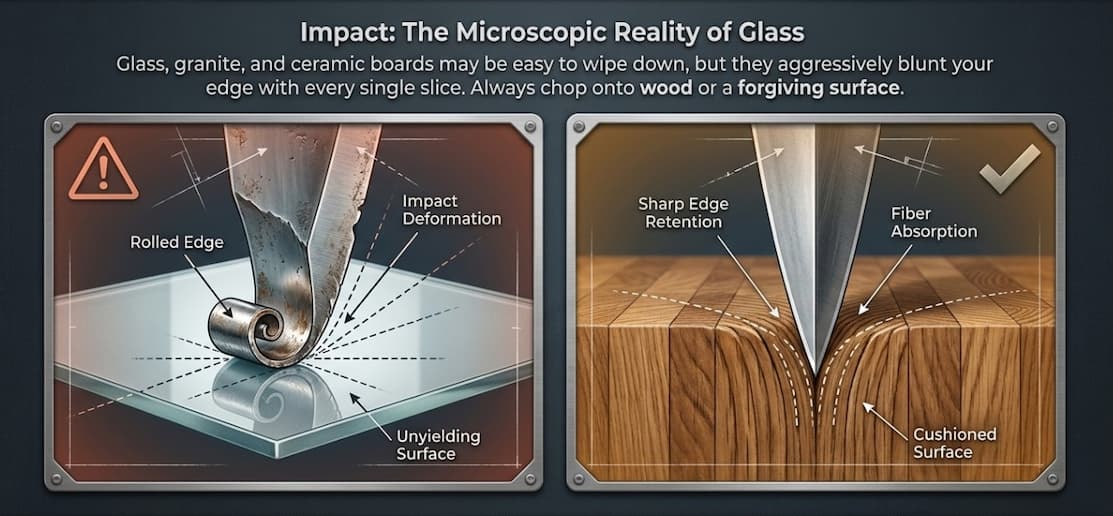
Let me say from the outset, you should always chop onto wood or another forgiving surface, NEVER onto glass, granite, metal, ceramic or any other hard, unrelenting material.
I know your glass chopping board is super easy to clean, but sorry, it is blunting the edge of your knife every time you use it. This is the case for all the above mentioned hard material boards. The ease of cleaning just isn't worth the damage you are inflicting on one of the most important tools in your kitchen.
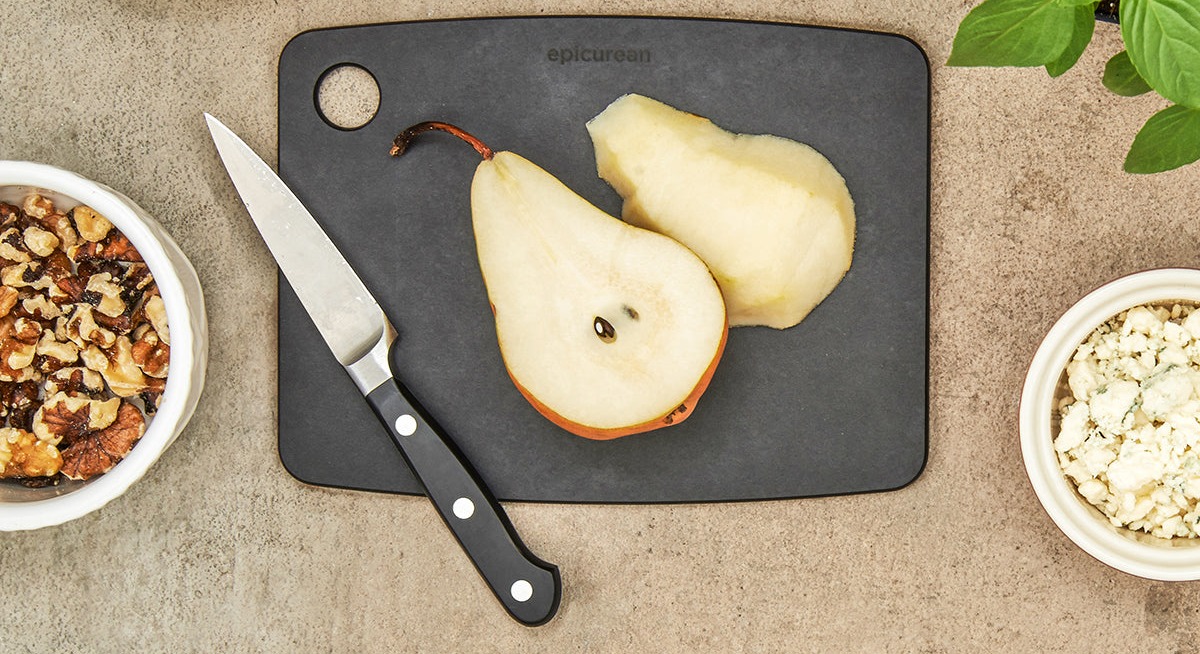
Use wooden boards or softer plastic/nylon-type boards (I really don’t like the latter, they were fashionable about 50 years ago, but they do stop the knives going blunt). Far far better, splash out on Epicurean chopping boards, which are thin, light, dishwasher safe, kind to knife blades, and are made from compressed wood pulp and resin. I have eight of them, four of which get used multiple times a day.
If you’re fit enough, a large butcher’s block is also lovely to look at and a delight to use. A bit of a bugger to wash up though, but saves on weight training.
Wood is kind not only to knives but also naturally antibacterial, although obviously proper cleaning still matters. Never leave a chopping board soaking in the sink and, do try to dry it standing on its long edge, that way the moisture drains more evenly rather than soaking into the end grain, which may otherwise begin to crack.


Cleaning
Some kitchen knives have handles that can survive the dishwasher, but no knife blades are unscathed by the attack of chemicals and heat. The edge will be dulled.
Hand wash is the only safe way to maintain your knives in tip-top condition.
Hand wash is the only safe way to maintain your knives in tip-top condition.
Knife storage
Knife storage matters both for safety and for keeping knives sharp. Throw them loose into a drawer and they become potentially dangerous while their carefully honed edges quickly become less carefully honed.
Put them in a block instead, where they’re easy to reach, look good and stay sharper for longer. We even do a knife block designed to sit inside a drawer if you absolutely must hide them away. If you’re especially masochistic you could buy blade guards and still keep them in a drawer, but what a faff.
Conclusion
I suppose what I’m really advocating here is pragmatism.
Not knife-snobbery, not obsessive gadgetry and certainly not performative sharpening rituals conducted by candlelight over Japanese waterstones! Just buying something good, looking after it properly and using it with pleasure. A knife looked after well, is exquisite to use. Nuff said.
Robert Welch Professional Range
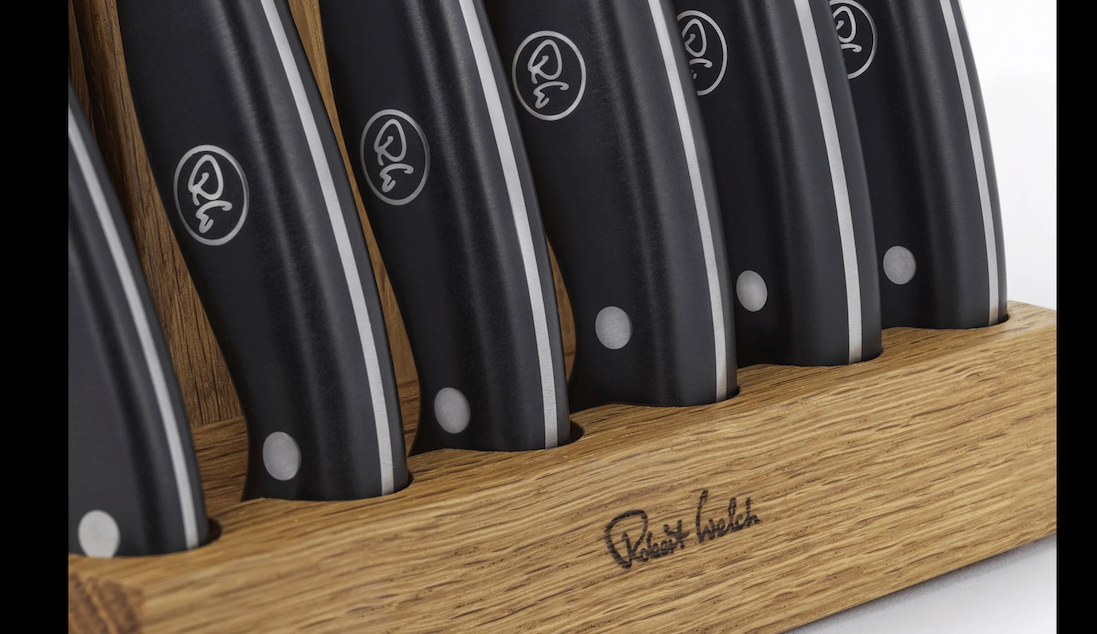
The eagle eyed among you will have noticed that I missed out the section on 'Buy good quality' in my overview above, that's because I thought it was an ideal opportunity to combine that point with my thoughts on one of my favourite knife manufacturers. A couple of years ago Robert Welch, whose distinctive Signature range we’ve sold for years, introduced an alternative range called “Professional”. At the time I didn’t really like their appearance and I chose not to stock them.
Truthfully, I still prefer the Signature handles, which are just so comfortable and handsome, whereas the Professional range initially struck me as looking rather like everyone else’s knives. But “people have started asking for them” so eventually I relented.
Maybe I was being a bit hasty in my dismissal of them because in actual fact, they do feel extremely good in the hand.
Comfort
Or at least in my hand, and that brings me to a point often ignored. The handle should feel comfortable in your hand and the knife should feel like an extension of it. Don’t underestimate the importance of comfort in determining whether you actually reach for the correct knife for the job.
And if you’re buying online, and therefore can’t try it before you buy it, remember that you can always send something back to us, even though it’s used, and we’ll issue a refund or do an exchange. All you pay for is the postage of the return.
Buy on comfort first. Price second.
This new range of Robert Welch Professional comprises:
• Robert Welch Bread Knife 22cm
• Robert Welch Carving Knife 22cm
• Robert Welch Cook’s Knives in 15cm, 18cm & 20cm
• Robert Welch Paring Knife 9cm
• Robert Welch Santoku 12cm, 14cm & 17cm
• Robert Welch Flexible Utility Knife 16cm
• Robert Welch Angle Oak Knife Block 7 Piece
• Robert Welch Book Oak Knife Block 7 Piece
10 Knives in all plus two Knife Blocks.
• Robert Welch Bread Knife 22cm
• Robert Welch Carving Knife 22cm
• Robert Welch Cook’s Knives in 15cm, 18cm & 20cm
• Robert Welch Paring Knife 9cm
• Robert Welch Santoku 12cm, 14cm & 17cm
• Robert Welch Flexible Utility Knife 16cm
• Robert Welch Angle Oak Knife Block 7 Piece
• Robert Welch Book Oak Knife Block 7 Piece
10 Knives in all plus two Knife Blocks.
The latter are beautiful to look at (as are pretty well everything that comes from this old design house) and particularly easy to use and great for under wall cupboards because, after a slight lift, the knives slide easily forwards, rather than needing to be pulled vertically upwards like a conventional block.
This week I’m offering you 20% off both the new Robert Welch “Professional Range” and the existing “Signature Range”.
If coming into the shops, simply tell us who you are.
If shopping online, use code RWPRO26.


Below is a recap including a few of my do’s and don'ts which may help you get the best performance, and life, out of your knives.
DO
• Keep knives sharp. A sharp knife is far far safer than a blunt one because it cuts predictably, doesn’t skid and so, is a joy to use.
• Keep knives sharp. A sharp knife is far far safer than a blunt one because it cuts predictably, doesn’t skid and so, is a joy to use.
• Use a proper chopping board. Wood, good-quality plastic or, better still, Epicurean (see above).
• Wash knives by hand with hot water and ideally dry them immediately.
• Store knives properly: knife block, magnetic rack or blade guards.
• Use the correct knife for the task.
• Hone regularly with a steel if you’re good at it or, being pragmatic, use a decent handheld sharpener instead. Wheel-based systems (Mino & Robert Welch) are kind to the blade, quick to use and highly effective.
• Sharpen properly when honing no longer restores the edge.
• Let the knife do the work, particularly with good chef’s knives.
• Respect the knife. Distraction and rushing are responsible for most accidents.
• Wash knives by hand with hot water and ideally dry them immediately.
• Store knives properly: knife block, magnetic rack or blade guards.
• Use the correct knife for the task.
• Hone regularly with a steel if you’re good at it or, being pragmatic, use a decent handheld sharpener instead. Wheel-based systems (Mino & Robert Welch) are kind to the blade, quick to use and highly effective.
• Sharpen properly when honing no longer restores the edge.
• Let the knife do the work, particularly with good chef’s knives.
• Respect the knife. Distraction and rushing are responsible for most accidents.
DON’T
• Put good knives in the dishwasher.
• Leave knives soaking in water.
• Throw knives loose into a drawer.
• Scrape chopped food off the board with the cutting edge use the spine instead.
• Twist the knife side to side when stuck in bone. Rock it out gently instead. Otherwise, there’s every chance you’ll leave a small section of the blade behind in the bone. Chipped knife. Tears. Expense.
• Pry with a knife.
• Use kitchen knives as screwdrivers, tin openers or box cutters.
• Cut on granite, marble, glass, metal or ceramic surfaces. It blunts the blade.
• Try to catch a falling knife, or a falling star for that matter. One will lacerate your hand and the other's too hot to handle.
• Use a blunt knife “for now”. Often tempting but can end in tears and a bloody mess.
• Store knives wet.
• Put good knives in the dishwasher.
• Leave knives soaking in water.
• Throw knives loose into a drawer.
• Scrape chopped food off the board with the cutting edge use the spine instead.
• Twist the knife side to side when stuck in bone. Rock it out gently instead. Otherwise, there’s every chance you’ll leave a small section of the blade behind in the bone. Chipped knife. Tears. Expense.
• Pry with a knife.
• Use kitchen knives as screwdrivers, tin openers or box cutters.
• Cut on granite, marble, glass, metal or ceramic surfaces. It blunts the blade.
• Try to catch a falling knife, or a falling star for that matter. One will lacerate your hand and the other's too hot to handle.
• Use a blunt knife “for now”. Often tempting but can end in tears and a bloody mess.
• Store knives wet.


So, thank you again Nick. You’ve managed to get (almost) 2,000 words out of me about knives, which frankly neither of us could have predicted.
May I wish you a pleasant and peaceful weekend.
Warm regards
Andrew
Leave a comment